Prepping for a Research Scientist, GenAI Position: A Pointer Notebook
Fifty-plus rounds across research labs and startups in twelve weeks, distilled into the map I wish I had on day one. Ordered the way you would build a system, from coding warmups to serving and alignment.
What this covers. My Research Scientist interviews in GenAI repeatedly covered five areas: coding, ML and CV fundamentals, research depth, system design, and behavioral questions. This notebook follows the preparation order that helped me connect them.
How to use it. Start with the map below and open the sections relevant to your role. Each combines a short explanation, equations or code where useful, and references for a deeper pass. It is a revision notebook, not a requirement to master every topic before applying.
Practical implication. Revise in the order you’d build a system: warm up with Python, cover ML and classical CV foundations, master the transformer, stack on diffusion and flow models, then climb to text-to-image and video, and only then worry about serving and RL alignment. This post is that order.
⚠️ Not exhaustive. I wrote this down from memory after my own full-time interview prep cycle. It is biased toward the things that worked for me and that came up repeatedly across different research labs I interviewed with, so there are whole areas (classical RL, speech, 3D, retrieval systems, robotics) that are barely here, simply because they didn’t show up in my loops. Use it as one data point among several, not as a complete syllabus.
📚 Companion notebook (dated). The paper-by-paper notes that fed this post live in my Notion literature notebook, with per-paper tags, figures, TL;DRs, methodology and limitation notes across HDR, SDR-to-HDR, diffusion, flow matching, video inverse tone mapping, and multimodal diffusion. Fair warning, it is a snapshot from my prep season. I no longer maintain it, so read it as dated context rather than a living resource.
🤝 Suggest additions. This is a living document. If you know a better resource, a missed topic, a cleaner derivation, or a recent paper that should be in the pointer set, please open an issue on the repo or email me at saini.2@utexas.edu. I’ll keep merging good additions in.
The shape of the loop
When I started preparing, I tried to study everything at once. After a few interview loops, I could separate the questions into five recurring areas. That made it easier to plan a session and see which area needed more work.
- Coding. Usually one LeetCode-medium plus one applied-ML question (“implement MLE for a Gaussian,” “write the forward pass for scaled dot-product attention,” “compute KV-cache memory for a given model shape”).
- ML / CV fundamentals. Losses, MLE vs MAP, KL divergence, SVM hinge loss, clustering, classical CV (SSIM/VIF/LPIPS, histogram equalization, Sobel), CNN output shape, BatchNorm vs LayerNorm, self-supervised learning.
- Research dive. Depth-first on one of your papers. Derive the loss, ablate components, predict what breaks under a change.
- System design. Build a T2I or T2V product end-to-end (data → latent space → backbone → training → eval → serving) in 45 minutes on a whiteboard.
- Paper trace + behavioral. Contrast 5–8 landmark papers in the team’s area in 30 seconds each; be ready with a 30-second, 2-minute, and 10-minute pitch of your own work.
- Vlad Feinberg: How to land a job at a frontier lab (2026). The most concrete, recent, frontier-lab-specific piece I’ve seen on what the loop actually optimizes for.
- John Schulman: An Opinionated Guide to ML Research. How to pick problems, structure your day, and not waste cycles.
- Andrej Karpathy: A Survival Guide to a PhD. Long, honest; still the best single read on how the apprenticeship phase actually works.
The full map (click any entry to jump)
Warming up
Foundations
- ML fundamentals. MLE/MAP, loss zoo (L1/L2/CE/hinge/triplet/KL), normalization, clustering, SVM.
- GenAI fundamentals. Generative vs discriminative, likelihood-based vs likelihood-free family tree.
- Classical CV. Histogram equalization, Sobel, Gaussian/median filters, NLM, SIFT, color theory, color spaces, Retinex.
- Perceptual quality. PSNR, SSIM, VIF, LPIPS/DISTS, NR-IQA, HDR quality, FID/FVD, CLIPScore/HPS/ImageReward, VBench/PhysGenBench, MLLM-as-judge.
- CNNs & SSL. ConvNet primer, contrastive and masked SSL.
The workhorse
The generative stack
- VAE & ELBO. Two derivations, reparameterization, VQ-VAE, SAE.
- DDPM. Forward chain, reverse parameterization, \(\epsilon\)-prediction, Tweedie.
- Score & SDE. DSM, EBM, VP/VE SDE, probability-flow ODE.
- Flow matching & rectified flow. Linear interpolant, reflow, mean flow, logit-normal time.
- Sampling & guidance. DDIM, Euler/Midpoint/Heun, CFG, classifier guidance, DPS, MPGD.
- Conditioning. AdaIN/FiLM/AdaLN, cross-attention, ControlNet, T2I-Adapter, LoRA, MM-DiT.
Systems that ship
- T2I design space. SD1 → SD3 → Flux → Nano Banana; why CLIP needed T5.
- Video generation. Temporal attention, LVDM, inverse tone mapping (SDR→HDR).
- Discrete diffusion. Transition matrix, MLDM/LLaDA.
- LLMs & nanoGPT. Tokenization, causal LM, sampling.
- Evaluation metrics. When each metric saturates.
Training & serving
- Training lifecycle. Pretraining, mid-training, post-training (SFT, preference tuning, RLHF), and the diffusion-specific analogues.
- Training nuances. Mixed precision, ZeRO, FSDP, gradient accumulation, EMA.
- Inference nuances. Quantization, distillation, pruning, continuous batching, vLLM/TensorRT-LLM.
- RL alignment in detail. PPO, DPO, GRPO, DAPO, Best-of-N.
Telling your story
Interview timeline
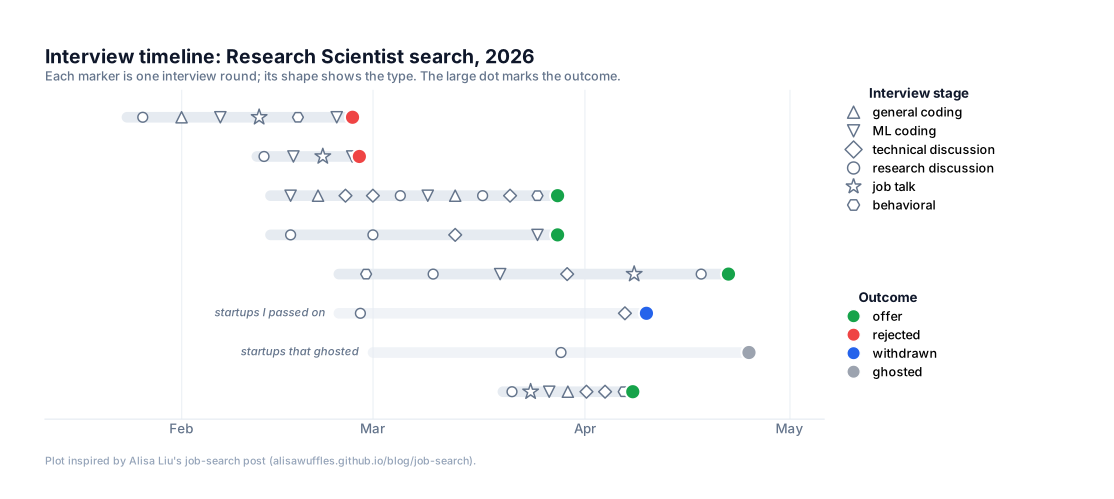
I started preparing in mid-to-late January 2026 and kept interviewing until mid-April, when I stopped with multiple offers in hand. Across those roughly twelve weeks I worked through ~8 to 10 companies and 50+ interviews in total, often running several processes in parallel: a mix of large labs and startups, plus a handful of exploratory startup conversations that never turned into full loops. The rounds cut across everything in this notebook: general and ML coding, ML breadth and depth, research talks and discussions, GenAI and fidelity, ML system design, and behavioral. A typical pipeline was a manager or recruiter call, then a screen, then an onsite loop of four to ten rounds compressed into a couple of weeks.
It did not all go one way. Several processes ended in offers, some ended in rejections, and several early startup chats fizzled into ghosting or me withdrawing. The plot below anonymizes the companies and shows each process as a horizontal track from first call to final decision, with a marker for every interview round (its shape gives the type) and a colored dot for the outcome. One caveat: this captures only the formal interviews. It leaves out the much larger amount of networking, referrals, and recruiter calls that set up each of these pipelines in the first place.
Coding rounds Python internals, applied-ML warmups, DSA cadence, and the ML-system-design checklist
Nearly every process opened with code, and I learned quickly that these rounds test fluency more than algorithmic brilliance. The real test is whether you can turn a small, well-specified idea into working Python without stalling. The questions came in two flavors: a standard LeetCode-medium, and an applied-ML exercise like “implement MLE for a Gaussian” or “write attention from scratch.” The second flavor is far more predictable than people expect, which makes it the highest-return thing to drill.
Python essentials
A few Python details are worth being able to explain clearly before the coding exercise.
- Execution model. CPython compiles source to bytecode and executes it in a virtual machine. PyPy uses a JIT. CPython also gained an optional experimental JIT in Python 3.13; the exact execution path depends on the build.
- PEP 8. 4-space indent, 79-char lines,
snake_casevariables,CamelCaseclasses. - Memory. Reference counting + generational GC. When refcount hits zero, the object is deallocated; the cyclic collector handles reference cycles.
*args, **kwargs. Variable positional (tuple) and keyword (dict) arguments.
Applied-ML warmups (run these in your head)
MLE for a Gaussian. Derive and code. \(\nabla_\theta \log\prod_i f(x_i;\theta)=0\) gives closed-form \(\hat\mu=\tfrac{1}{N}\sum x_i,\ \hat\sigma^2=\tfrac{1}{N}\sum(x_i-\hat\mu)^2\).
import numpy as np

def gaussian_mle(x):
    mu = x.mean()
    sigma2 = ((x - mu) ** 2).mean()
    return mu, sigma2

# MAP with Gaussian prior N(mu0, tau2) on mu, known sigma2
def gaussian_map_mean(x, sigma2, mu0, tau2):
    n = len(x)
    return (mu0 / tau2 + x.sum() / sigma2) / (1 / tau2 + n / sigma2)
CNN output shape. For input width \(W\), filter \(F\), stride \(S\), padding \(P\):
\[ O = \left\lfloor\frac{W - F + 2P}{S}\right\rfloor + 1 \]
k-th smallest. Heap, \(O(n\log k)\):
import heapq
def kth_smallest(nums, k):
    return heapq.nsmallest(k, nums)[-1]
Naive attention forward pass. The single most common whiteboard ask.
import torch, math

def attention(q, k, v, mask=None):
    # q, k, v: (B, H, T, d_k)
    scores = (q @ k.transpose(-2, -1)) / math.sqrt(q.size(-1))
    if mask is not None:                       # causal mask shape (T, T)
        scores = scores.masked_fill(mask == 0, float('-inf'))
    attn = torch.softmax(scores, dim=-1)
    return attn @ v, attn
DSA cadence
What worked for me: 1 hour/day of LeetCode plus 2 structured hours, 2–3 problems daily, 300 most-frequent list over ~2 months[1]. Pattern list:
- Two pointers & sliding window (longest substring, k-distinct, min window).
- Binary search on the answer (Koko bananas, split array largest sum).
- Heap / priority queue (top-k, merge-k-lists, schedulers).
- Monotonic stack (daily temperatures, largest rectangle).
- Dynamic programming (1D, 2D, on intervals, trees, bitmask).
- Graph BFS/DFS, Dijkstra, topological sort, union-find.
- Backtracking (permutations, combinations, N-queens).
- Bit manipulation and prefix-sum tricks.
ML system-design checklist (T2I/T2V)
- Data. Crawl → filter (CLIP relevance, aesthetics, dedup, NSFW), recaption with a VLM.
- Latent space. Train VAE / VQ-VAE / advanced VAE with perceptual + adversarial loss.
- Backbone. MM-DiT scale; positional encoding (RoPE 2D/3D); FSDP or ZeRO-3 sharding.
- Training. Flow matching with logit-normal time; EMA; mixed precision.
- Eval harness. Prompt set × metrics (CLIPScore, HPSv2, ImageReward, VBench, MLLM-judge).
- Inference. Heun/DPM-Solver; step distillation; FP8/INT8; CFG annealing; continuous batching for AR heads.
- Safety. Prompt pre-filter, output post-filter, concept-erasing LoRA.
Deep dive: NeetCode Coding Interview Roadmap · Karpathy: Neural Networks: Zero to Hero for the applied-ML coding muscle.
Machine learning fundamentals MLE and MAP, the loss-function zoo, normalization, clustering, SVM and kernels
It is tempting to skim this layer when the job title says GenAI. Don’t. The fundamentals rounds were where interviewers checked whether the diffusion knowledge sits on solid ground. The questions were rarely exotic: losses, estimators, normalization, clustering, asked plainly and then pushed one level deeper (“why does \(L_1\) promote sparsity?”, “when does BatchNorm break?”). This is the material to be boringly reliable on.
MLE and MAP
\[ \theta^\text{MLE} = \arg\max_\theta \prod_i p(x_i\mid\theta), \quad \theta^\text{MAP} = \arg\max_\theta \prod_i p(x_i\mid\theta)\,p(\theta). \]
Practical identity: maximizing likelihood equals minimizing negative log-likelihood equals minimizing cross-entropy against empirical data distribution.
The loss-function zoo
- \(L_1\) and \(L_2\). As a penalty on parameters, \(L_1\) encourages sparsity. As a regression loss, absolute error targets a conditional median and is less sensitive to large residuals than squared error. Squared error targets a conditional mean. Keep the regularizer and reconstruction-loss interpretations separate.
- Cross-entropy. Canonical classification/token-level loss.
- Hinge (SVM). \(\arg\min \tfrac{1}{2}\|w\|^2 + C\sum_i \max(0, 1 - y_i(w^\top x_i - b))\).
- Triplet. \(\max(0, d(A,P) - d(A,N) + m)\). Enforces anchor–positive closer than anchor–negative by margin \(m\).
- KL divergence. \(D_\text{KL}(p\Vert q)=\sum p\log(p/q)\). Non-negative, asymmetric, zero iff equal.
import torch.nn.functional as F

def kl_divergence(p, q, eps=1e-12):              # both shape (..., C)
    return (p * (p.clamp_min(eps).log() - q.clamp_min(eps).log())).sum(-1)

def hinge_loss(scores, y):                        # y in {-1, +1}
    return F.relu(1 - y * scores).mean()

def triplet_loss(a, p, n, margin=1.0):
    d_ap = (a - p).norm(dim=-1)
    d_an = (a - n).norm(dim=-1)
    return F.relu(d_ap - d_an + margin).mean()
Normalization
- BatchNorm. For convolutional features, statistics are computed per channel across batch and spatial dimensions during training. Small or unrepresentative batches can make those estimates unreliable; inference normally uses running statistics.
- LayerNorm. Normalize per-sample across features. Batch-size independent; the default for transformers.
- RMSNorm. LayerNorm without mean subtraction; \(\tfrac{1}{\sqrt{\text{RMS}(x)^2+\varepsilon}}\cdot x\). Used in LLaMA-family models.
- GroupNorm. Middle ground used inside UNets and DiT blocks.
Clustering (quick)
- K-means. Hard assignment via nearest centroid; iterative \((\text{assign}, \text{update})\).
- GMM. Soft clustering with \(K\) Gaussians \((\mu_k,\Sigma_k,\pi_k)\) via EM; ellipsoidal clusters.
- DBSCAN. Density-based; arbitrary-shape clusters; noise is a first-class output.
SVM and kernels
An SVM fits a separating hyperplane \(w^\top x+b\) while trading margin width against classification errors. A kernel computes inner products \(K(x,y)=\phi(x)^\top\phi(y)\) in a feature space without constructing those features explicitly. Mapping to that space does not guarantee perfect separation.
Deep dive: Stanford CS229 (Andrew Ng) for the math · StatQuest with Josh Starmer for 10-minute intuition videos on MLE, PCA, SVM, GMM, clustering.
Generative modeling fundamentals Generative vs discriminative, the model family tree, autoregressive factorization
Before any diffusion math, several interviewers started one level up: what does it even mean to model a distribution, and why did the field walk away from GANs? Having a clean thirty-second answer here (generative modeling learns \(p(x)\) or \(p(x,y)\), discriminative modeling learns \(p(y\mid x)\) directly), plus a mental family tree of the model classes turned those openings into easy points.
Family tree
- Likelihood-based: VAE, autoregressive, diffusion, normalizing flows, energy-based models.
- Likelihood-free: GANs, min-max adversarial, strong images at small scale but prone to mode collapse; WGAN-GP mitigates with a Lipschitz critic and gradient penalty.
Why the shift? Sampling directly from \(p(x)\) in high-dim is intractable; simpler to transport a Gaussian base to the data via a tractable forward corruption and a learned reverse, the diffusion/flow-matching recipe the generative-stack sections build up.
Autoregressive factorization
\[ p_\theta(x) = p_\theta(x_1)\,p_\theta(x_2\mid x_1)\cdots p_\theta(x_L\mid x_{<L}) \]
Loss collapses to token-level CE. Sampling: top-\(k\) (restrict to top \(k\) logits) or nucleus (top-\(p\)) sampling.
Deep dive: Lilian Weng: From Autoencoder to Beta-VAE · HF CV Course: Generative Models (Unit 5).
Classical computer vision Filters, histogram equalization, SIFT, color theory and color spaces
I half expected classical CV to be a relic, and I was wrong. For imaging and video roles it surfaced in almost every fundamentals round, usually as a rapid-fire sequence: how does histogram equalization work, which filter kills salt-and-pepper noise, what actually defines a color space. If your day job is transformers, this is the layer most worth a deliberate refresher. The questions are easy if you have seen them in the last month and surprisingly hard if you haven’t.
Image processing primitives
- Histogram equalization. Remap intensities through the CDF of the image’s histogram: \(\text{img}'[i,j] = \text{CDF}(\text{img}[i,j])\cdot 255\). Boosts contrast on low-dynamic-range imagery.
- Sobel edges. \(G_x=\begin{bmatrix}-1&0&1\\-2&0&2\\-1&0&1\end{bmatrix},\ G_y=G_x^\top,\ |G|=\sqrt{G_x^2+G_y^2}\).
- Gaussian filter. Low-pass \(\tfrac{1}{16}\begin{bmatrix}1&2&1\\2&4&2\\1&2&1\end{bmatrix}\) smooths additive noise.
- Median filter. Best for salt-and-pepper noise (Gaussian blur makes it worse).
- Non-Local Means (NLM). Compare patches not pixels; average similar patches within a search window.
- SIFT. Scale-invariant keypoint detection via Difference-of-Gaussians; assign orientation; 128-dim descriptor.
import numpy as np
from scipy.ndimage import convolve

def sobel(img):
    img = np.asarray(img, dtype=np.float64)
    Gx = np.array([[-1,0,1],[-2,0,2],[-1,0,1]])
    Gy = Gx.T
    gx, gy = convolve(img, Gx), convolve(img, Gy)
    return np.sqrt(gx**2 + gy**2)

def hist_eq(img):                                  # img: uint8
    hist, _ = np.histogram(img.ravel(), 256, (0,256))
    cdf = hist.cumsum()
    if img.size == 0 or np.count_nonzero(hist) <= 1:
        return img.copy()
    cdf_min = cdf[hist > 0][0]
    lut = np.clip((cdf - cdf_min) * 255 / (img.size - cdf_min), 0, 255)
    return lut[img].astype(np.uint8)
Color theory and color spaces
Color constancy describes how perceived surface color can remain relatively stable as illumination changes. Retinex models explain part of this through comparisons across spatial context and cone responses. The effect has limits, especially under unusual lighting.
- sRGB and Rec. 709. They share primaries and a D65 white point, but their transfer-function conventions differ. Neither color gamut by itself specifies a bit depth.
- Rec. 2020 and HDR. Rec. 2020 defines a wide-gamut UHD color system. HDR television uses Rec. 2100 with PQ or HLG transfer functions; a wide gamut alone does not make a signal HDR.
- XYZ (CIE 1931). Device-independent linear space.
- LAB. Perceptually uniform: \(L\) lightness, \(a\) green–red, \(b\) blue–yellow.
For an RGB encoding, distinguish primaries, white point, transfer function, and numeric range. PQ and HLG also need a display and viewing context. These details matter when comparing or converting images.
Deep dive: Szeliski: Computer Vision: Algorithms and Applications (2nd ed., free PDF) · Cambridge in Colour tutorials for color theory, gamut, transfer functions.
Perceptual quality assessment PSNR, SSIM, VIF, LPIPS, NR-IQA, FID and FVD, HDR-specific quality
Quality assessment is my own research area, so I am biased about its importance, but for generative-media roles it genuinely is the difference between “we trained a model” and “we know whether it got better.” Interviewers used it in two ways: as a fundamentals check (write down SSIM, explain what VIF is measuring) and as a judgment check (which metric would you actually trust for this product, and when does it stop meaning anything).
Full-reference (FR)
- PSNR. \(10\log_{10}(255^2/\text{MSE})\). Pixel fidelity; weak human correlation.
- SSIM. Luminance × contrast × structure: \(\text{SSIM}(x,y)=\frac{(2\mu_x\mu_y+C_1)(2\sigma_{xy}+C_2)}{(\mu_x^2+\mu_y^2+C_1)(\sigma_x^2+\sigma_y^2+C_2)}\).
- VIF.[2] Visual Information Fidelity: model images as natural-scene statistics (NSS) via Gaussian Scale Mixtures in a wavelet basis; HVS has internal noise \(n\); distortion adds attenuation \(g\) and noise \(v\); compute MI ratio \(\text{VIF} = I(C;F_\text{dist})/I(C;F_\text{ref})\).
- LPIPS. Feature-space distance over a frozen VGG with learned per-layer weights.
- DISTS. Structure + texture similarity in learned feature space; less sensitive to texture shifts.
No-reference (NR)
- NSS-based: NIQE, BRISQUE, MSCN.
- Learned: Re-IQA, CONTRIQUE, DOVER[3] (decouples aesthetic and technical quality for video), Q-Align, DEQA (MLLM-based).
Generative-model metrics
- FID / FVD. Frechet distance of Inception (image) or I3D (video) features; saturates for SOTA T2I.
- CLIPScore. Cosine of CLIP text–image embeddings; good for alignment, weak for realism.
- HPSv2 and ImageReward. Both learn human preferences, using different datasets: HPD v2 for HPSv2 and expert-annotated comparisons for ImageReward. PickScore is associated with Pick-a-Pic. [4]
- VBench / VBenchv2.[5] Multi-facet video eval (subject identity, motion smoothness, dynamic degree, spatial relations).
- PhysGenBench / VideoPhy2. Physics commonsense for video.
- MLLM-as-judge. Cheap holistic eval with a capable VLM (Gemini, Qwen-VL, GPT-4o).
HDR-specific
Tone-mapped previews can hide HDR clipping, highlight detail, and brightness errors. Evaluate the intended HDR signal with display-aware methods such as HDR-VDP or perceptually encoded metrics, then check the results under controlled viewing conditions. The HDR-Q slides cover our work on HDR-aware learned assessment.
Deep dive: UT LIVE Lab publications for the IQA/VQA canon (SSIM, VIF, BRISQUE, NIQE, VMAF) · LPIPS repo + paper · VBench project page.
CNNs and self-supervised learning ConvNet arithmetic, contrastive and masked self-supervised learning
This is the bridge between classical CV and the transformer era. CNN questions tended to be quick arithmetic (output shapes, receptive fields) while SSL questions tended to be conceptual: why InfoNCE works, how BYOL avoids collapse, what MAE’s 75% masking buys. Both are cheap to revise and embarrassing to fumble.
CNN primer
Stanford CS231n is still the canonical course for this layer of the stack[6]. Quick hits:
- Convolution as learnable filter banks; parameter sharing + spatial equivariance.
- Receptive field grows with depth; dilated convs expand it cheaply.
- ResNet identity shortcuts enable very deep training; ConvNeXt revisits CNNs with transformer-style design.
Self-supervised learning
- Contrastive: SimCLR, MoCo. InfoNCE loss: \(\mathcal{L} = -\log\tfrac{\exp(q\cdot k^+/\tau)}{\sum_i \exp(q\cdot k_i/\tau)}\).
- BYOL / DINO. Non-contrastive; online + EMA target networks.
- Masked image modeling (MAE). Mask 75% of patches, reconstruct; strong downstream classification.
- CLIP. Contrastive on (image, caption) pairs; InfoNCE across the batch.
def info_nce(q, k_pos, k_neg, tau=0.07):           # shapes: (B,d),(B,d),(B,K,d)
    logits_pos = (q * k_pos).sum(-1, keepdim=True) / tau
    logits_neg = (q.unsqueeze(1) * k_neg).sum(-1) / tau
    logits = torch.cat([logits_pos, logits_neg], dim=-1)
    labels = torch.zeros(q.size(0), dtype=torch.long, device=q.device)
    return F.cross_entropy(logits, labels)
Deep dive: Stanford CS231n for CNNs · Lilian Weng: Contrastive Representation Learning · Meta AI: DINO blog.
Transformers, end to end Attention in full, RoPE and ALiBi, FlashAttention, GQA and MLA, KV-cache math
If I had to bet on a single topic appearing somewhere in a loop, it would be this one. The transformer showed up in every disguise: as a coding exercise (write multi-head attention), as a systems question (size the KV cache for a 30B model), and as an architecture discussion (why RoPE, why GQA). At some point I stopped treating it as one topic and started treating it as a small curriculum (attention, positions, memory), and that is how this section is laid out.
Attention in full
\[ \text{Attn}(Q,K,V) = \text{softmax}\!\left(\tfrac{QK^\top}{\sqrt{d_k}}\right)V. \]
Why \(\sqrt{d_k}\)? The dot product of two \(d_k\)-dim unit-variance vectors has variance \(d_k\). Without scaling, softmax saturates into near-one-hot distributions and gradients vanish on the un-picked tokens.
Cross-attention: \(Q\) from decoder sequence, \(K,V\) from encoder sequence (e.g., T5 tokens in a T2I UNet / DiT).
Masked attention: add a \(-\infty\) bias to forbidden positions before softmax. Causal masking is the lower-triangular case.
import torch, math, torch.nn.functional as F

class MultiHeadAttention(torch.nn.Module):
    def __init__(self, d_model, n_heads):
        super().__init__()
        assert d_model % n_heads == 0
        self.h, self.dk = n_heads, d_model // n_heads
        self.qkv = torch.nn.Linear(d_model, 3 * d_model)
        self.out = torch.nn.Linear(d_model, d_model)

    def forward(self, x, mask=None):
        B, T, D = x.shape
        q, k, v = self.qkv(x).chunk(3, dim=-1)
        q, k, v = [t.view(B, T, self.h, self.dk).transpose(1, 2) for t in (q, k, v)]
        s = q @ k.transpose(-2, -1) / math.sqrt(self.dk)
        if mask is not None:
            s = s.masked_fill(mask == 0, float('-inf'))
        a = F.softmax(s, dim=-1)
        y = (a @ v).transpose(1, 2).contiguous().view(B, T, D)
        return self.out(y)
Sparse, Flash, Linear, GQA, MLA
- Sparse attention. If each of \(T\) queries attends to \(k\) selected keys, attention products cost roughly \(O(Tkd)\), excluding the selection overhead. The sparsity pattern determines which long-range interactions remain available.
- Native Sparse Attention (NSA). Combines token compression (coarse windowed pooling of K/V), selection (top-\(k\) via importance scores), and sliding window (local); the three paths are gated-summed.
- Flash Attention.[7] Tiling + online (safe) softmax reduces memory from \(O(N^2)\) to \(O(N)\). Key identity: maintain running max \(m_i\) and denominator \(d_i\) so
exp(x - m)never overflows, then rescale on each new tile. - Linear attention. Feature-map methods reassociate \(\phi(Q)(\phi(K)^\top V)\) to avoid a full token-by-token attention matrix. Cost depends on feature dimension, and the resulting attention is not generally identical to softmax attention.
- Grouped-query attention (GQA). Several query heads share each key/value head, reducing KV-cache size. The ratio is model-specific. [8]
- Multi-head Latent Attention (MLA).[9] Compress K/V into a low-rank latent then project back at attention time; ~4–10× KV-cache reduction.
Positional encoding
- Sinusoidal. \(\text{PE}(\text{pos}, 2i)=\sin(\text{pos}/10000^{2i/d})\). Length-independent. Added to input embeddings.
- RoPE[10]. Rotate \(q, k\) by a position-dependent angle before the dot product. \(q^\top k\) becomes sensitive only to the relative angle. 2D RoPE splits embedding into \((x, y)\) chunks for images; 3D RoPE further for video \((t, x, y)\).
- ALiBi[11]. Add linear negative bias \(-m\cdot|i-j|\) in attention logits; acts as soft local attention; extrapolates cleanly to longer sequences.
def rope_1d(x, theta=10000.0):                     # x: (B, T, d) with d even
    B, T, d = x.shape
    pos = torch.arange(T, device=x.device).float()[:, None]
    i = torch.arange(d // 2, device=x.device).float()
    freq = 1.0 / (theta ** (2 * i / d))
    angles = pos * freq                            # (T, d/2)
    cos, sin = angles.cos(), angles.sin()
    x1, x2 = x[..., 0::2], x[..., 1::2]
    xr = torch.stack([x1*cos - x2*sin, x1*sin + x2*cos], dim=-1)
    return xr.flatten(-2)
KV cache memory
\[ \text{mem} = 2 \times \text{bytes} \times n_\text{layers} \times d_\text{model} \times \text{seq\_len} \times \text{batch}. \]
For ordinary multi-head attention with 48 layers, hidden width 7,168, FP16 storage, sequence length 1,024, and batch size 128, this is about 180 GB. With GQA, replace \(d_{\mathrm{model}}\) in the cache formula by \(n_{\mathrm{KV\ heads}}d_{\mathrm{head}}\). The architecture matters as much as the parameter count.
def kv_cache_bytes(layers, d_model, seq_len, batch, dtype_bytes=2):
    return 2 * dtype_bytes * layers * d_model * seq_len * batch

kv_cache_bytes(48, 7168, 1024, 128) / 1e9          # ~180 GB
FFN, SwiGLU, norms
An FFN applies an input projection, a nonlinearity, and an output projection. SwiGLU uses two projections of the same input: \(\operatorname{SiLU}(xW_g)\odot(xW_u)\), followed by an output projection \(W_d\).
Deep dive: Jay Alammar: The Illustrated Transformer · The Annotated Transformer (Harvard NLP) · Karpathy: “Let’s build GPT: from scratch” · Sebastian Raschka: A Visual Guide to Attention Variants.
VAE and the ELBO The ELBO two ways, reparameterization, closed-form KL, VQ-VAE
The generative stack starts with the VAE for two reasons. The ELBO is the single most requested derivation in fundamentals rounds, and every latent diffusion model rests on a VAE doing quiet, load-bearing work underneath. I practiced writing both derivations until each took under a minute.
VAE[12]: encoder \(q_\phi(z\mid x)\), decoder \(p_\theta(x\mid z)\). Evidence lower bound:
\[ \log p_\theta(x) \ge \mathbb{E}_{q_\phi(z\mid x)}[\log p_\theta(x\mid z)] - D_\text{KL}\big(q_\phi(z\mid x)\,\Vert\,p(z)\big). \]
Derivation A (Jensen):
\[ \log p_\theta(x) = \log\int q_\phi(z\mid x)\tfrac{p_\theta(x,z)}{q_\phi(z\mid x)}dz \ge \mathbb{E}_{q_\phi}\log\tfrac{p_\theta(x,z)}{q_\phi(z\mid x)}. \]
Derivation B (chain rule):
\[ \log p_\theta(x) = \mathbb{E}_{q_\phi}\log\tfrac{p_\theta(x,z)}{q_\phi(z\mid x)} + D_\text{KL}\big(q_\phi(z\mid x)\,\Vert\,p_\theta(z\mid x)\big). \]
The gap (right term) tightens as the encoder matches the true posterior.
Reparameterization trick & closed-form KL
For \(q_\phi(z\mid x)=\mathcal{N}(\mu_\phi,\sigma_\phi^2 I)\) and \(p(z)=\mathcal{N}(0,I)\):
\[ z = \mu_\phi + \sigma_\phi\odot\epsilon,\ \epsilon\sim\mathcal{N}(0,I),\quad D_\text{KL} = \tfrac{1}{2}\sum_d(\mu_d^2 + \sigma_d^2 - 1 - 2\log\sigma_d). \]
class VAE(torch.nn.Module):
    def __init__(self, enc, dec):
        super().__init__(); self.enc, self.dec = enc, dec
    def forward(self, x):
        mu, log_sigma = self.enc(x).chunk(2, dim=-1)
        z = mu + log_sigma.exp() * torch.randn_like(mu)   # reparameterize
        x_rec = self.dec(z)
        kl = 0.5 * (mu.pow(2) + (2*log_sigma).exp() - 1 - 2*log_sigma).sum(-1)
        rec = ((x - x_rec) ** 2).flatten(1).sum(-1)
        return (rec + kl).mean(), x_rec
VQ-VAE and advanced VAEs
A VAE with a simple pixelwise likelihood can produce blurred reconstructions; a strong decoder can also ignore its latent variables. VQ-VAE uses a discrete codebook and a different training objective. Modern latent generators vary in channel count, compression, reconstruction losses, and latent normalization, so check the autoencoder used by the specific model. [13]
Deep dive: Lilian Weng: From Autoencoder to Beta-VAE · Doersch: Tutorial on VAEs (arXiv 1606.05908).
DDPM Forward chain, the epsilon-loss, ancestral sampling, Tweedie’s formula
This is the anchor of the whole stack. Every sampler, guidance trick, and inverse-problem method later in the notebook is a manipulation of the objects defined here, so the forward chain and the \(\epsilon\)-loss are worth over-learning. They were the two things I could still write down at the end of a four-round day.
Forward Markov chain[14]:
\[ q(x_t\mid x_{t-1}) = \mathcal{N}(\sqrt{1-\beta_t}\,x_{t-1}, \beta_t I),\quad q(x_t\mid x_0) = \mathcal{N}(\sqrt{\bar\alpha_t}\,x_0, (1-\bar\alpha_t)I). \]
\(\bar\alpha_t = \prod_{s\le t}(1-\beta_s)\). One-shot corruption: \(x_t = \sqrt{\bar\alpha_t}x_0 + \sqrt{1-\bar\alpha_t}\epsilon\).
Training objective
\[ \mathcal{L}_\text{simple}(\theta) = \mathbb{E}_{t,x_0,\epsilon}\!\left[\|\epsilon - \epsilon_\theta(\sqrt{\bar\alpha_t}x_0+\sqrt{1-\bar\alpha_t}\epsilon,t)\|^2\right]. \]
def ddpm_loss(model, x0, alphas_bar):
    t = torch.randint(0, len(alphas_bar), (x0.size(0),), device=x0.device)
    ab = alphas_bar[t].view(-1, 1, 1, 1)
    eps = torch.randn_like(x0)
    xt = ab.sqrt() * x0 + (1 - ab).sqrt() * eps
    eps_pred = model(xt, t)
    return F.mse_loss(eps_pred, eps)
Ancestral sampler
\[ x_{t-1} = \tfrac{1}{\sqrt{\alpha_t}}\!\left(x_t - \tfrac{\beta_t}{\sqrt{1-\bar\alpha_t}}\epsilon_\theta(x_t,t)\right) + \sigma_t z. \]
Tweedie’s formula
\[ \hat x_{0\mid t} = \tfrac{1}{\sqrt{\bar\alpha_t}}(x_t - \sqrt{1-\bar\alpha_t}\,\epsilon_\theta(x_t, t)). \]
The single identity that powers DDIM, classifier guidance in data space, DPS, and every “predict \(\hat x_0\)” parameterization.
Deep dive: Lilian Weng: What are Diffusion Models? · Calvin Luo: Understanding Diffusion Models: A Unified Perspective · HF Diffusion Models Course.
Score-based models and the SDE umbrella Denoising score matching, VP and VE SDEs, the probability-flow ODE
This is where interviews separate memorized DDPM from understood DDPM. The score view explains why diffusion works, and the SDE framing is what lets you answer follow-ups like “what is DDIM actually doing?” without hand-waving.
The score is \(s(x) = \nabla_x\log p(x)\). Denoising score matching[15] sidesteps the intractable partition function of energy-based models \(p_\theta(x)=\tfrac{1}{Z(\theta)}\exp(-f_\theta(x))\):
\[ \mathcal{L}(\theta) = \tfrac{1}{2}\mathbb{E}_{x,\tilde x}\!\left[\|s_\theta(\tilde x) - \nabla_{\tilde x}\log q(\tilde x\mid x)\|^2\right]. \]
Song et al.[16] unified DDPM and NCSN under a continuous-time SDE \(dx_t = f(x_t,t)dt + g(t)dw_t\) with reverse \(dx_t = [f(x_t,t) - g^2(t)\nabla_x\log p_t(x_t)]dt + g(t)d\bar w_t\).
| Discrete | Continuous | |
|---|---|---|
| NCSN → VE-SDE | \(f=0,\ g=\sqrt{d\sigma^2/dt}\) | \(dx=g(t)dw\) |
| DDPM → VP-SDE | \(f=-\tfrac{1}{2}\beta(t)x,\ g=\sqrt{\beta_t}\) | \(dx=-\tfrac{1}{2}\beta(t)x\,dt+\sqrt{\beta_t}dw\) |
The probability-flow ODE changes the drift as well as removing noise: \(dx_t=[f(x_t,t)-\tfrac12 g^2(t)\nabla_x\log p_t(x_t)]dt\). With the exact score it shares the marginals of the SDE. Likelihood evaluation additionally requires integrating the change in log density.
Deep dive: Yang Song: Generative Modeling by Estimating Gradients of the Data Distribution · Karras et al. EDM.
Flow matching and rectified flow Linear interpolant, velocity regression, reflow, logit-normal time sampling
Flow matching is central to SD3, Flux, and several video generators. For interview preparation, start with the linear interpolant and velocity-regression objective, then explain how the sampling ODE follows from them.
Flow matching[17] learns a velocity field \(v_\theta(x,t)\) transporting base \(p_0\) to data \(p_1\). Rectified Flow[18] uses the linear coupling \(x_t=(1-t)x_0+tx_1\), target \(v^\star(x,t)=\mathbb{E}[x_1-x_0\mid x_t=x,t]\):
\[ \mathcal{L}_\text{RF}(\theta)=\mathbb{E}_{(x_0,x_1)\sim\pi,\,t\sim\rho}\!\left[\|v_\theta(x_t,t)-(x_1-x_0)\|^2\right]. \]
def rf_loss(model, x1):
    x0 = torch.randn_like(x1)
    t = torch.rand(x1.size(0), device=x1.device)         # uniform
    tb = t.view(-1, 1, 1, 1)
    xt = (1 - tb) * x0 + tb * x1
    v_target = x1 - x0
    v_pred = model(xt, t)
    return F.mse_loss(v_pred, v_target)
Reflow. After first training, retrain on self-generated pairs \((x_0,\hat x_1)\). Curvature drops, few-step sampling becomes viable. For a dedicated walk-through see my Rectified Flow note.
Logit-normal time sampling. SD3 studies nonuniform time sampling, including \(t=\operatorname{sigmoid}(z)\) for Gaussian \(z\). This changes the weight given to different noise levels; its effect depends on the distribution parameters and time convention.
Mean flow. Predict average velocity over an interval \([t_1, t_2]\); approximates single-step generation.
Deep dive: NeurIPS 2024 Tutorial: Flow Matching for Generative Modeling · Google DeepMind: Diffusion Meets Flow Matching blog.
Sampling and guidance DDIM, ODE solvers, classifier-free guidance, DPS and MPGD
Training objectives get the reverence, but sampling is where generation quality is actually won or lost, and where my own research lives, so these were the rounds I looked forward to. The recurring asks: the DDIM update, why CFG has that strange extrapolation form, and how you steer a pretrained model through an inverse problem.
DDIM
DDIM uses a family of non-Markovian sampling updates. The common deterministic version sets the sampling-noise scale to zero. [19]
\[ x_{t-1} = \sqrt{\bar\alpha_{t-1}}\,\hat x_{0\mid t} + \sqrt{1-\bar\alpha_{t-1}-\sigma_t^2}\,\epsilon_\theta(x_t,t) + \sigma_t z. \]
With \(\sigma_t=0\), this update is deterministic. The forward-process construction preserves the training marginals; a learned reverse model and a finite sampling grid still introduce approximation error.
@torch.no_grad()
def ddim_sample(model, alphas_bar, steps, shape, device, eta=0.0):
    xt = torch.randn(shape, device=device)
    ts = torch.linspace(len(alphas_bar) - 1, 0, steps + 1).long().to(device)
    for i in range(steps):
        t_now, t_nxt = ts[i], ts[i + 1]
        ab, ab_nxt = alphas_bar[t_now], alphas_bar[t_nxt]
        eps = model(xt, t_now.expand(shape[0]))
        x0_hat = (xt - (1 - ab).sqrt() * eps) / ab.sqrt()
        sigma = eta * ((1 - ab_nxt) / (1 - ab) * (1 - ab / ab_nxt)).sqrt()
        noise = torch.randn_like(xt) if eta > 0 else 0
        xt = ab_nxt.sqrt() * x0_hat + (1 - ab_nxt - sigma**2).sqrt() * eps + sigma * noise
    return xt
ODE solvers
Higher-order ODE solvers can reduce discretization error, but may require more model evaluations per step. Compare at matched function-evaluation or wall-clock budgets.
- Euler. \(x_{t+h}=x_t+h\,v_\theta(x_t,t)\), with signed step \(h\). For integration from noise at \(t=1\) to data at \(t=0\), \(h<0\).
- Midpoint. Half-step then evaluate at midpoint.
- Heun. Euler step, re-evaluate, average (2nd order).
- DPM-Solver and EDM. DPM-Solver uses the semilinear structure of diffusion ODEs. EDM studies preconditioning, schedules, and sampling choices, including Heun's method. [20]
Classifier-free guidance (CFG)
Train one network on both conditional \(\epsilon_\theta(x,t,c)\) and unconditional \(\epsilon_\theta(x,t,\varnothing)\) by randomly dropping \(c\). At inference:
\[ \tilde\epsilon = \epsilon_\theta(x,t,\varnothing) + w\,(\epsilon_\theta(x,t,c) - \epsilon_\theta(x,t,\varnothing)). \]
@torch.no_grad()
def cfg_eps(model, x, t, c, w=7.5):
    eps_c   = model(x, t, c)
    eps_unc = model(x, t, None)
    return eps_unc + w * (eps_c - eps_unc)
On flow models, naive CFG amplifies trajectory curvature; my Rectified-CFG++[21] fixes this with a predictor-corrector step.
Classifier guidance, DPS, MPGD
Classifier guidance.[22] \(\nabla_x\log p(x\mid c) = \nabla_x\log p(c\mid x) + \nabla_x\log p(x)\). Uses a differentiable classifier.
DPS. For observations \(y=A(x)+n\) with Gaussian noise, one approximation is \(\nabla_{x_t}\log p(y\mid x_t)\approx-\tfrac{1}{2\sigma_y^2}\nabla_{x_t}\|y-A(\hat x_{0\mid t})\|^2\). This uses a point estimate in place of integrating over possible clean images, and guidance strength needs tuning. [23]
MPGD.[24] Project the guidance update back onto the manifold via a VAE/autoencoder tangent. Extra forward pass; big quality win.
Deep dive: Sander Dieleman: Guidance: a cheat code for diffusion models · Sander Dieleman: Perspectives on diffusion.
Conditioning in generative models AdaLN and FiLM, cross-attention, ControlNet, T2I-Adapter, LoRA, MM-DiT
“How would you add control X to a pretrained model?” is a favorite system-design probe precisely because it has no single right answer. It tests whether you know the menu and can argue trade-offs. The menu has three families; real systems combine them.
-
Architectural injection
- Concatenation \([x, c]\), the GAN/AR default.
- Cross-attention, the T2I workhorse.
- Conditional norms:
- AdaIN: \(\gamma(c)\tfrac{x-\mu(x)}{\sigma(x)}+\beta(c)\).
- FiLM: \(c\to(\gamma,\beta)\to\gamma\odot x+\beta\).
- AdaLN / AdaLN-Zero: LayerNorm with scale/shift from \(c\); DiT/MM-DiT.
- Guidance methods: CFG, classifier guidance, attention-guided sampling.
- Spatial / structural conditioning
class LoRALinear(torch.nn.Module):
    def __init__(self, base: torch.nn.Linear, r=8, alpha=16):
        super().__init__()
        self.base = base
        for p in base.parameters(): p.requires_grad_(False)
        self.A = torch.nn.Parameter(torch.randn(r, base.in_features) * 0.02)
        self.B = torch.nn.Parameter(torch.zeros(base.out_features, r))
        self.scale = alpha / r
    def forward(self, x):
        return self.base(x) + (x @ self.A.T @ self.B.T) * self.scale
MM-DiT (SD3 / Flux)
Caption encoded jointly by CLIP-L/14, CLIP-G/14, and T5-XXL. Pooled CLIP + sinusoidal timestep → MLP → AdaLN-Zero modulation. T5 token sequence is concatenated with image patch tokens; joint self-attention across the combined sequence, with per-stream norms and projections. AdaLN-Zero initializes modulation scale to zero so blocks act as identity at the start of training.
Deep dive: ControlNet paper · HF PEFT: LoRA conceptual guide · SD3 / MM-DiT paper.
The text-to-image design space SD1 through Flux, why CLIP needed T5, the scaling rule
Whiteboard rounds almost always converged to some version of “design a text-to-image product.” The saving grace is that every modern T2I/T2V system decomposes along the same few axes (training objective, latent space, backbone, text encoder), so one well-memorized grid covers a decade of models and lets you place any new release in thirty seconds.
| Model | Training | Latent | Backbone | Text |
|---|---|---|---|---|
| SD 1/2 | DDPM | VQ-GAN | UNet | CLIP |
| SD 3 / Flux 1 | Flow matching | Advanced VAE | DiT / MM-DiT | CLIP + T5 |
| Flux 2 / Z-Image / Qwen-Image | Flow matching | Advanced VAE | MM-DiT | LLM/VLM/MLLM + MM-DiT |
| Transfusion / Hunyuan 3.0 | Flow matching | Advanced VAE | Native-MM | Native MM tokens |
| Nano Banana / GPT-4o Image | FM + diffusion head | Advanced VAE | Native-MM | Native MM + tools |
Why CLIP alone stalled as text encoder
- Spatial relations (“dog left of cat”) is weak.
- Negation (“room without a window”) fails.
- Counting and fine-grained attributes fail.
- The 77-token cap is too short.
T5-XXL handles long captions, dense semantics, and compositional detail; SD3/Flux use both (CLIP for pooled, T5 for token sequence). Flux 2-era models drop CLIP and use a single LLM/VLM encoder.
Scaling rule
A common Chinchilla-style training reference is roughly 20 training tokens per parameter, not more parameters than data points. It describes a particular compute-optimal language-model setting; inference cost, repeated data, and image or video tokenization change the tradeoff. [36]
Deep dive: Stability AI: SD3 research blog · Black Forest Labs: Flux announcement · Transfusion paper (Meta).
Video generation and inverse problems Temporal attention, latent video diffusion, inverse tone mapping
Video is where compute reality bites: joint 3D attention over space and time is prohibitive at any interesting resolution, and nearly every design choice in this section is a response to that one fact. For video-adjacent roles, expect at least one temporal-attention question and one “how does model X differ from Sora?”
Temporal attention strategies
The workarounds for full 3D attention:
- Window attention. Current frame + last \(k\) neighbors.
- Sliding window. Stride < window; smoother transitions.
- Factorized spatial–temporal. Alternate spatial and temporal blocks (Lumiere, Hunyuan-Video).
- Token compression. Compress older frames into fewer K/V tokens.
Latent video diffusion
Shared outline across Movie Gen, Sora, Veo, Hunyuan-Video, Wan, OpenSora:
- 3D VAE (or causal 3D VAE) to compress space + time.
- MM-DiT backbone with alternating / joint 3D attention.
- Flow matching + CFG at inference.
- Camera / motion conditioning via cross-attention with motion tokens.
Inverse Tone Mapping (SDR→HDR)
From my LumaFlux line of work:
- Gain-map learning. Predict per-pixel gain scaling SDR luminance.
- Diffusion-prior ITM. Start from SDR conditioning, generate the HDR residual; Physically-Guided Adaptation (PGA) + Perceptual Cross-Modulation (PCM).
- Rational Quadratic Spline (RQS) decoder. Learnable invertible tone curve.
Deep dive: OpenAI: Sora technical report · Hunyuan-Video tech report · Meta: Movie Gen.
Discrete diffusion Transition matrices, masked diffusion, MLDM and LLaDA
A short but increasingly common tangent: “diffusion works on pixels, so what happens on tokens?” With the dLLM line heating up, this went from a curiosity to a real question, and it costs about ten minutes to prepare.
For tokens/molecules, noising is random state transitions. Transition matrix \(Q\) gives
\[ x_t\mid x_{t-1}\sim\text{Cat}(p=x_{t-1}Q_t),\quad x_t\mid x_0\sim\text{Cat}(p=x_0\bar Q_t). \]
Reverse posterior
\[ q(x_{t-1}\mid x_t,x_0)=\operatorname{Cat}\!\left(\frac{(x_tQ_t^\top)\odot(x_0\bar Q_{t-1})}{x_0\bar Q_t x_t^\top}\right). \] Here states are one-hot row vectors; the denominator is a scalar normalization.
MLDM, LLaDA[28], and the dLLM line apply this to text generation, the language-side analogue of image diffusion.
Deep dive: Austin et al.: Structured Denoising Diffusion Models in Discrete State-Spaces (D3PM) · LLaDA paper.
LLMs, GPT, and nanoGPT Tokenization, the causal LM objective, nanoGPT, sampling strategies
Even for image and video roles, a working knowledge of the LLM stack kept coming up. Text encoders, captioners, and MLLM judges are all LLMs in the loop. The comforting part is that all modern decoder-only LLMs are thin wrappers around the same stack: tokenizer → embedding → \(N\)× (RMSNorm, MHA with RoPE and GQA/MLA, RMSNorm, SwiGLU FFN) → LM head. Karpathy’s nanoGPT[29] is the smallest fluent reference. Read it end-to-end.
class GPTBlock(torch.nn.Module):
    def __init__(self, d, h):
        super().__init__()
        self.ln1 = torch.nn.LayerNorm(d)
        self.attn = MultiHeadAttention(d, h)
        self.ln2 = torch.nn.LayerNorm(d)
        self.ffn = torch.nn.Sequential(
            torch.nn.Linear(d, 4*d), torch.nn.GELU(),
            torch.nn.Linear(4*d, d),
        )
    def forward(self, x, mask):
        x = x + self.attn(self.ln1(x), mask)
        x = x + self.ffn(self.ln2(x))
        return x
Sampling
- Top-k. Keep highest-probability \(k\) tokens, renormalize.
- Nucleus (top-p). Smallest set with cumulative probability \(\ge p\).
- Temperature. Scale logits by \(1/T\) before softmax.
Deep dive: Karpathy: Let’s build GPT from scratch · Stanford CS336: Language Modeling from Scratch.
Evaluation metrics, consolidated Every metric in one table, and when each one stops meaning anything
The perceptual-quality section covered image metrics in depth; this is the cross-modality cheat sheet I kept on a single page.
| Modality | Fidelity | Alignment | Preference | Holistic |
|---|---|---|---|---|
| Image gen | FID, PSNR, SSIM, VIF, LPIPS | CLIPScore, VQAScore | HPSv2, ImageReward | MLLM-judge, HEIM |
| Video gen | FVD, CLIP-Temp/FrameSim | CLIPScore over frames | (learned) | VBench v2, PhysGenBench, VideoPhy2 |
| LLM | perplexity | BLEU, ROUGE | ArenaHard, AlpacaEval | MMLU, GSM8K, HELM |
Deep dive: Stanford HELM and HEIM for holistic LLM / image eval · VBench leaderboard for video.
The training lifecycle Pretraining, mid-training, SFT, RLHF, DPO, GRPO, distillation, and the diffusion analogues
A useful system-design answer separates broad pretraining, continued training for new data or capabilities, and task or preference post-training. The boundaries vary between projects. This section maps their objectives and data; the later RL section gives the losses.
Pretraining
Pretraining learns from a broad dataset using the model's base objective, such as next-token prediction or denoising. Dataset selection and filtering remain important at this stage.
- Objective (LLM). Next-token cross-entropy \(\mathcal{L} = -\mathbb{E}_{x}\sum_{t}\log p_\theta(x_t\mid x_{<t})\).
- Objective (diffusion/FM). \(\epsilon\)-prediction or velocity regression (see the DDPM and flow matching sections). Trained on web-scale image–text pairs (LAION-5B, DataComp, CommonPool, internal crawls).
- Data. FineWeb / FineWeb-Edu, RedPajama, RefinedWeb, The Stack, plus code/math specialty mixes. Quality filtering (CLIP score, perplexity, fastText) and heavy deduplication matter more than raw volume.
- Compute profile. Long horizon (weeks–months), thousands of accelerators, LR warmup + cosine decay, effective batches of ~4M tokens, FP8/BF16 mixed precision, ZeRO-3 or FSDP sharding.
- Eval. Perplexity on held-out mix; a small suite of in-domain probes (MMLU, HumanEval for LLMs; small FID/CLIPScore for image models). Full eval comes later.
Mid-training (a.k.a. continued pretraining, annealed pretraining)
A second, smaller pretraining stage that reshapes the model’s capability profile before alignment. Much more impactful than the literature suggests.
- Long-context extension. Extend context from 4K/8K to 32K → 128K → 1M. Techniques: RoPE base rescaling (NTK-aware, YaRN), PI (position interpolation), needle-in-haystack eval.
- Capability injection. Upsample math (OpenWebMath, NuminaMath), code (The Stack v2), reasoning chains. The “annealing” trick: near the end of pretraining, switch the data mix heavily toward high-quality sources and drop LR sharply.
- Domain adaptation. Medical / legal / finance / multilingual corpora.
- For image/video models: resolution curriculum (64 → 256 → 1024 → native), aspect-ratio bucketing, human-aesthetic filtering, synthetic-caption rewriting with a VLM.
Post-training
Turn a raw next-token predictor / image denoiser into something that actually follows instructions and matches human preferences.
Supervised fine-tuning (SFT)
Continue the pretraining objective on a curated set of (instruction, high-quality response) pairs. Scale: 10K–1M examples; lower LR (1e-5 to 5e-6 range); 1–3 epochs. Loss is the same token-level CE but only on the response tokens (mask the prompt).
def sft_loss(logits, labels, response_mask):
    # logits: (B, T, V); labels: (B, T); response_mask: (B, T) 1 where response
    shift_logits = logits[:, :-1].contiguous()
    shift_labels = labels[:, 1:].contiguous()
    shift_mask = response_mask[:, 1:].contiguous().float()
    ce = F.cross_entropy(shift_logits.transpose(1, 2), shift_labels, reduction='none')
    return (ce * shift_mask).sum() / shift_mask.sum().clamp_min(1)
SFT datasets can combine human-written instructions, existing task data, and teacher-generated examples. Their proportions depend on the project.
Preference data collection
Preference data contain a prompt \(x\) and responses with a preference \(y_w\succ y_l\). Labels may come from people or AI feedback. UltraFeedback is an example of AI-generated feedback, not a human-labeled dataset.
Reward modeling + RLHF (PPO)
Fit a scalar reward model \(r_\phi(x,y)\) to preferences via a Bradley–Terry logistic loss \(\mathcal{L}_{RM} = -\log\sigma(r_\phi(x,y_w) - r_\phi(x,y_l))\). Then PPO the policy with \(r_\phi\) plus a per-token KL anchor \(r_t = r_\phi(x,y) - \beta\log\tfrac{\pi_\theta(y_t\mid\cdot)}{\pi_\text{ref}(y_t\mid\cdot)}\). Full math and loss in the RL alignment section.
Direct Preference Optimization (DPO)
Skip the reward model. Optimize the policy directly on preference pairs (derivation in the RL alignment section). In practice DPO is the baseline for almost every open-source post-training pipeline because it is stable, single-loop, and reward-model-free.
GRPO / DAPO, critic-free RL
Sample \(N\) responses per prompt, normalize rewards within the group, apply PPO-style token-level clipping. GRPO removed the value network entirely; DAPO further fixes clipping, sampling, and gradient-dilution pathologies. See the RL alignment section.
Rejection sampling / Best-of-N
Generate \(N\) candidates, score each with a reward model, keep the best. Embarrassingly simple, widely used as both a baseline and for generating SFT data for the next iteration (“rejection-sampling fine-tuning”, RSFT).
Constitutional AI / RLAIF
Replace human preference labels with AI-generated critiques against a written constitution. Scales preference collection to millions of examples cheaply; most frontier labs use a hybrid of human + AI labels.
On-policy distillation (OPD)
Classic sequence-level / off-policy KD trains the student on a fixed pile of teacher-generated outputs (the “distillation SFT” above). The student never sees its own mistakes, so it inherits the usual exposure-bias / train–inference mismatch. On-policy distillation fixes this: the student samples its own rollouts and the teacher supplies dense, per-token supervision on those trajectories, minimizing a (typically reverse, mode-seeking) KL \(\mathrm{KL}(\pi_\theta \,\|\, \pi_\text{teacher})\) over the student’s own distribution.
On-policy distillation supplies teacher targets at states visited by the student. That addresses a train-inference mismatch, but does not guarantee better sample efficiency for every task. Teacher inference and access to its token probabilities are part of the cost.
- Forward vs reverse KL. Forward KL on teacher samples is mass-covering; reverse KL on student samples is mode-seeking and stops the student putting probability where the teacher has none (MiniLLM, GKD).
- Multi-teacher OPD. Score the student’s rollouts with several teachers at once (average / gate their logits, weight by per-token confidence, or route to per-domain specialists) to transfer complementary skills and damp single-teacher bias.
- Cost. One teacher forward pass per student rollout: pricier than static SFT, far cheaper than full RL reward plumbing; speculative / partial-sequence variants trim it further.
Deep dive: Thinking Machines: On-Policy Distillation · GKD: Agarwal et al. · MiniLLM: Gu et al.
Post-training for diffusion / flow models
The same ideas transfer. “Response” becomes “generated image/video” and the reward is an image preference / aesthetic / alignment score (ImageReward, HPSv2, PickScore, VQAScore).
- SFT for diffusion. Fine-tune with the standard diffusion loss on a curated high-quality subset (e.g., aesthetically filtered, human-preferred).
- Diffusion-DPO. DPO adapted to the diffusion objective: compare noise predictions on winning vs losing images per timestep.
- DRaFT / ReFL / AlignProp. Backprop a differentiable reward through truncated sampling; very effective at preference alignment but compute-heavy.
- DPOK. PPO-style policy gradient on the diffusion sampler.
- LoRA preference tuning. Do any of the above through low-rank adapters for cheap style / aesthetic personalization.
Deep dive: Nathan Lambert: The RLHF Book · Interconnects: Post-Training 101 · HF Alignment Handbook · DeepSeek-R1 technical report.
Training nuances Mixed precision, ZeRO and FSDP, memory back-of-envelope, EMA
The follow-up to any architecture answer is “fine, now train it on 512 GPUs.” These are the mechanics that turn a loss function into a run that actually converges: precision choices, sharding strategies, memory arithmetic, and the small rituals like EMA that practitioners treat as non-negotiable.
Mixed precision
FP32 master copy + FP16/BF16 computation; loss scaling to prevent underflow of small gradients; BF16 is preferred (same exponent range as FP32, no loss scaling needed).
Data-parallel vs ZeRO vs FSDP
- DDP. Every GPU has a full model copy; gradients all-reduced each step.
- ZeRO-1/2/3[30]: shard optimizer state, then gradients, then parameters across GPUs.
- FSDP[31]: PyTorch-native ZeRO-3 equivalent; all-gather + reduce-scatter per layer; integrates with activation checkpointing.
Memory budget back-of-envelope
A common mixed-precision Adam budget is 2 bytes per parameter for model weights, 2 for gradients, 8 for FP32 moments, and 4 for an FP32 master copy: about 16 bytes per parameter, or 112 GB for 7B parameters, before activations and temporary buffers. Some implementations omit the master copy or use different dtypes, so inspect the actual optimizer state.
Gradient accumulation & EMA
Accumulating \(k\) microbatches gives an effective batch of \(Bk\) per data-parallel worker without retaining every microbatch graph. It still requires gradient buffers. EMA weights are common in diffusion training; compare them with the live weights and account for their storage.
class EMA:
    def __init__(self, model, decay=0.999):
        self.decay = decay
        self.shadow = {n: p.detach().clone() for n, p in model.named_parameters()}
    @torch.no_grad()
    def update(self, model):
        for n, p in model.named_parameters():
            self.shadow[n].mul_(self.decay).add_(p.detach(), alpha=1 - self.decay)
Deep dive: HF: The Ultra-Scale Playbook (Training LLMs on GPU Clusters) · PyTorch FSDP Advanced Tutorial.
Inference nuances Quantization, pruning, distillation, continuous batching, serving stacks
Serving questions were the most product-flavored of my loops: given a trained model, how do you make it cheap and fast without wrecking quality? The toolbox is small and composable. Shrink the numbers, shrink the model, batch smarter.
Quantization
FP32 → FP16 (×2) → INT8 (×4) → INT4 (×8). Two common schemes:
- Zero-point (asymmetric). Map \([x_\min, x_\max]\) to \([0, 2^b-1]\); preserves zero exactly, which matters for ReLU activations.
- Absolute-max (symmetric). Map \([-|x|_\max, |x|_\max]\) to \([-2^{b-1}, 2^{b-1}-1]\).
def quantize_int8_symmetric(x):
    x = x.float()
    scale = (x.abs().max() / 127).clamp_min(torch.finfo(x.dtype).tiny)
    q = (x / scale).round().clamp(-127, 127).to(torch.int8)
    return q, scale

def dequantize(q, scale):
    return q.float() * scale
AWQ rescales channels to make weight quantization less damaging; GPTQ uses approximate second-order information; AQLM uses additive codebooks. They are different methods. LLM.int8() handles outlier features in higher precision while quantizing the rest. [32]
Pruning and distillation
- Pruning. Zero the lowest-magnitude \(x\%\) of weights per layer; structured pruning zeros entire heads/channels. Retrain or LoRA-adapt to recover.
- Distillation. Student learns \(\text{CE}(\text{student}, \text{true}) + \lambda\,D_\text{KL}(\text{student}\Vert\text{teacher})\).
- Few-step distillation. Distribution-matching methods train a student to match a teacher's output distribution. Consistency models use consistency along noising trajectories. Both can reduce sampling steps, but they use different objectives.
Serving stacks
- vLLM. A serving engine with paged KV-cache management and continuous batching.
- TensorRT-LLM. NVIDIA's inference stack with optimized kernels and model-specific serving paths. Compare it on your model, hardware, and traffic pattern.
- Continuous batching. Merge new requests into in-flight batches at every decode step; throughput ↑ by 2–5× over static batching.
Deep dive: Anyscale: Continuous batching for LLM inference · vLLM: PagedAttention blog.
RL alignment in detail PPO, DPO, GRPO, DAPO, and Best-of-N, written out in equations
PPO, DPO, GRPO, and DAPO solve related but distinct training problems. DPO fits preference pairs without online reward-model rollouts. PPO and GRPO use on-policy samples; GRPO estimates advantages from groups instead of a learned value function. DAPO modifies that group-based recipe.
PPO + RLHF
Typical PPO-based RLHF uses a trainable policy and value function, a reward model, and a frozen reference policy for the KL penalty. The clipped surrogate to maximize is
\[ J_{\mathrm{PPO}}=\mathbb{E}\left[\min\left(r_t A_t,\operatorname{clip}(r_t,1-\varepsilon,1+\varepsilon)A_t\right)\right],\qquad r_t=\frac{\pi_\theta(a_t\mid s_t)}{\pi_{\mathrm{old}}(a_t\mid s_t)}. \]
The ratio uses the policy that collected the rollout, \(\pi_{\mathrm{old}}\). The KL penalty instead compares with the frozen reference \(\pi_{\mathrm{ref}}\). GAE supplies the advantage estimate; these are separate roles.
DPO
DPO[33] aligns on preference pairs \((y_w, y_l)\) without a reward model:
\[ \mathcal{L}_\text{DPO} = -\mathbb{E}\!\left[\log\sigma\!\left(\beta\log\tfrac{\pi_\theta(y_w)}{\pi_\text{ref}(y_w)} - \beta\log\tfrac{\pi_\theta(y_l)}{\pi_\text{ref}(y_l)}\right)\right]. \]
def dpo_loss(pol_w, pol_l, ref_w, ref_l, beta=0.1):
    # pol_w, ref_w: log-probs under policy / reference for chosen
    # pol_l, ref_l: same for rejected
    return -F.logsigmoid(beta * ((pol_w - ref_w) - (pol_l - ref_l))).mean()
GRPO
GRPO[34] drops the critic. For each prompt, sample \(N\) responses, score, and normalize within group:
\[ A_i = \tfrac{r_i - \text{mean}(R_\text{group})}{\text{std}(R_\text{group})+\varepsilon}. \]
def grpo_advantages(rewards):                      # rewards: (G,)
    return (rewards - rewards.mean()) / (rewards.std(unbiased=False) + 1e-6)
DAPO
DAPO addresses four GRPO failure modes[35]:
- Clip-Higher. Use different lower and upper clipping bounds to preserve more exploration.
- Dynamic sampling. Filter prompt groups with no reward variation and keep sampling to assemble informative groups.
- Token-level loss. Aggregate over tokens across the batch to avoid underweighting long responses.
- Overlong reward shaping. Reduce reward noise from truncated responses with explicit length handling.
Best-of-N
Sample \(N\) outputs at \(T=0.7\), rank by reward model, keep the best. Embarrassingly simple, hard to beat at small \(N\).
Deep dive: HF blog: From GRPO to DAPO and GSPO · HF TRL library docs (DPO, PPO, GRPO implementations) · algoroxyolo: RL reading list (2026).
Paper trace and behavioral Three papers, three durations each, and the behavioral frame
Research discussions gave me the best chance to connect the interview to work I knew deeply. I prepared three papers and practiced explaining the problem, the main decision, and the evidence for each.
- Rectified-CFG++ (NeurIPS 2025). “Standard CFG breaks on flow models because it amplifies trajectory curvature. We introduce a predictor-corrector guidance with zero extra training cost that fixes artifacts on Flux, SD3, and Lumina-Next, improves text rendering, and comes with theoretical guarantees.” (blog).
- HDR-Q (CVPR 2026). “First multimodal LLM for HDR video quality assessment, with HAPO: contrastive KL, dual-entropy regularization, and SigLIP-2 HDR-aware encoding.” (slides).
- LumaFlux. “SDR-to-HDR inverse tone mapping using Flux 12B; 17M trainable parameters via PGA, PCM, and a Rational Quadratic Spline decoder.” (slides).
Rehearse three lengths: 30-second, 2-minute, 10-minute. Let the interviewer pick.
Checklist for the night before The compressed night-before pass over everything above
The compressed version of everything above, the pass I did the evening before every onsite. If any line takes more than a minute to reconstruct, that is the section to reopen.
- Python basics (GC, PEP 8,
*args/**kwargs), 60 seconds. - MLE for a Gaussian with code.
- CNN output formula with one worked example.
- Scaled dot-product attention from scratch, derive and code.
- RoPE 1D/2D/3D, ALiBi, sinusoidal: pros/cons each.
- KV cache back-of-envelope (30B, 48-layer, 7168-dim).
- FlashAttention online softmax identity.
- VAE ELBO both derivations in 60 seconds.
- DDPM forward + reverse + \(\epsilon\) loss with code.
- Tweedie and \(\hat x_{0\mid t}\).
- VP-SDE vs VE-SDE table.
- Rectified flow loss, reflow, logit-normal time.
- DDIM step (stochastic ↔ deterministic).
- CFG in \(\epsilon\) and score form.
- DPS vs MPGD.
- T2I design-space table.
- SSIM, PSNR, VIF intuition; when FID saturates.
- Retinex and color spaces; PQ vs HLG.
- PPO / DPO / GRPO / DAPO one-liners with DAPO fixes.
- Three papers of my own, three durations each.
- One LeetCode-medium on the morning of.
Curated reading list Courses, blogs, playbooks, and question banks worth your hours
Resources I came back to repeatedly during prep. Grouped by ladder stage.
Foundations (DL / CUDA / CV)
- Bishop & Bishop: Deep Learning: Foundations and Concepts (2023). Modern, textbook-level replacement for Goodfellow; full HTML is free.
- Dive into Deep Learning (d2l.ai). Continuously updated; interactive PyTorch/JAX code alongside every chapter.
- Karpathy: Neural Networks: Zero to Hero + nanoGPT / nanochat. Micrograd → makemore → GPT → tokenizers → nanochat, end-to-end and all runnable.
- Lilian Weng’s Lil’Log. Still unmatched as a survey blog for attention, VAEs, diffusion, SSL, RLHF, alignment.
- Jay Alammar. Visual explanations of transformers, LLMs, embeddings.
- 3Blue1Brown: Neural Networks series. The best visual intuition for backprop and attention.
- Chris Olah’s blog and Distill. Mechanistic / interpretability intuition that still transfers.
- Stanford CS336: Language Modeling from Scratch (Percy Liang, Tatsu Hashimoto, 2024/2025). The single best modern “build an LLM end-to-end” course.
- Stanford CS25: Transformers United. Guest-lecture series with authors of many of the papers you’ll be asked about.
- Stanford CS231n (latest semester). Still canonical for CNNs and the vision stack.
- NVIDIA CUDA C++ Programming Guide + the GPU Mode lecture series / Discord. Modern, kernel-writing-focused CUDA learning path that supersedes the older tutorials.
- Hugging Face Computer Vision Course for hands-on CV with modern backbones.
- Alisa Liu: Math notes New. Compact Notion notebook of the linear algebra, probability, and optimization results that keep resurfacing in interviews.
SSL & GANs
- Self-Supervised Representation Learning: Lilian Weng.
- Contrastive Representation Learning: Lilian Weng.
- awesome-self-supervised-learning.
- Goodfellow NIPS 2016 GAN Tutorial.
Transformers, LLMs, GPT
- Attention Is All You Need.
- The Illustrated Transformer.
- Sebastian Raschka: A Visual Guide to Attention Variants. MHA, MQA, GQA, MLA, sliding-window, Flash, with diagrams.
- Hugging Face LLM Course.
- karpathy/nanoGPT, ng-video-lecture.
- karpathy/nanochat, a minimal end-to-end ChatGPT stack.
- Stanford CS224N.
- Alisa Liu: A Book of LLMs New. Running Notion notebook on LLM architecture, training, and inference internals.
Diffusion / Flow Matching / Rectified Flow
- What are Diffusion Models?: Lilian Weng.
- Understanding Diffusion Models: A Unified Perspective: Calvin Luo.
- Hugging Face Diffusion Models Course.
- Flow Matching for Generative Modeling: Lipman et al..
- Flow Straight and Fast (Rectified Flow): Liu et al..
- Rectified Flow official repo.
- NeurIPS 2024 Tutorial: Flow Matching for Generative Modeling.
- MIT 6.S184 “The Principles of Diffusion Models and Flow Matching” (spring 2026). Course notes are the densest single source I know.
Training large models
- DeepSpeed, ZeRO tutorial.
- HF Accelerate FSDP docs, PyTorch Advanced FSDP.
- Efficient Training of Large Language Models on Distributed Infrastructure (2024 survey).
- Hugging Face Ultra-Scale Playbook, on training LLMs on GPU clusters.
- Hugging Face Smol Training Playbook, secrets to building world-class small LLMs.
Inference
- LLM.int8(): Dettmers et al..
- HF × bitsandbytes 8-bit integration.
- Continuous batching for LLM inference.
- vLLM, TensorRT-LLM.
RL alignment
- RLHF Book: Nathan Lambert.
- From GRPO to DAPO and GSPO: HF blog.
- algoroxyolo: RL reading list (2026), a curated, modern RL-for-LLMs reading map.
Interview question banks
- alirezadir/Machine-Learning-Interviews.
- amitshekhariitbhu/machine-learning-interview-questions.
- Devinterview-io/llms-interview-questions.
- LLM Interview Q&A Hub.
- llmgenai/LLMInterviewQuestions.
- a-tabaza/genai_interview_questions.
- awesome-generative-ai-guide.
- A Book for ML/DL Interview Questions (arXiv).
Coding practice
- NeetCode 150.
- LeetCode. Target the 300 most-frequent list.
- FAANG-Coding-Interview-Questions.
- Graph series (Aditya Verma), DP series, Recursion series.
References Every paper cited in the notebook
- NeetCode: LeetCode pattern-based prep.
- Sheikh & Bovik, Image Information and Visual Quality (VIF), IEEE TIP 2006.
- Wu et al., DOVER: Exploring Video Quality Assessment Through Aesthetic and Technical Perspectives, 2022.
- Wu et al., Human Preference Score v2 (HPSv2), 2023.
- Huang et al., VBench: Comprehensive Benchmark Suite for Video Generative Models, 2023.
- Stanford CS231n: Convolutional Neural Networks for Visual Recognition.
- Dao et al., FlashAttention: Fast and Memory-Efficient Exact Attention, 2022.
- Ainslie et al., GQA: Training Generalized Multi-Query Transformer Models, 2023.
- DeepSeek-V2 Technical Report (introduces MLA), 2024.
- Su et al., RoFormer: Enhanced Transformer with Rotary Position Embedding, 2021.
- Press et al., Train Short, Test Long: Attention with Linear Biases (ALiBi), 2021.
- Kingma & Welling, Auto-Encoding Variational Bayes, 2013.
- van den Oord et al., Neural Discrete Representation Learning (VQ-VAE), 2017.
- Ho et al., Denoising Diffusion Probabilistic Models, 2020.
- Song & Ermon, Generative Modeling by Estimating Gradients of the Data Distribution, 2019.
- Song et al., Score-Based Generative Modeling through Stochastic Differential Equations, 2021.
- Lipman et al., Flow Matching for Generative Modeling, 2022.
- Liu et al., Flow Straight and Fast: Rectified Flow, 2022.
- Song et al., Denoising Diffusion Implicit Models, 2020.
- Karras et al., Elucidating the Design Space of Diffusion-Based Generative Models (EDM), 2022.
- Saini et al., Rectified CFG++ for Flow Based Models, NeurIPS 2025.
- Dhariwal & Nichol, Diffusion Models Beat GANs on Image Synthesis (Classifier Guidance), 2021.
- Chung et al., Diffusion Posterior Sampling for General Noisy Inverse Problems (DPS), 2022.
- He et al., Manifold Preserving Guided Diffusion (MPGD), 2023.
- Zhang et al., Adding Conditional Control to Text-to-Image Diffusion Models (ControlNet), 2023.
- Mou et al., T2I-Adapter, 2023.
- Hu et al., LoRA: Low-Rank Adaptation of Large Language Models, 2021.
- Nie et al., Large Language Diffusion Models (LLaDA), 2025.
- karpathy/nanoGPT.
- Rajbhandari et al., ZeRO: Memory Optimizations Toward Training Trillion Parameter Models, 2019.
- Zhao et al., PyTorch FSDP: Experiences on Scaling Fully Sharded Data Parallel, 2023.
- Dettmers et al., LLM.int8(): 8-bit Matrix Multiplication for Transformers at Scale, 2022.
- Rafailov et al., Direct Preference Optimization, 2023.
- Shao et al., DeepSeekMath (GRPO), 2024.
- From GRPO to DAPO and GSPO: HF Blog (Yihua Zhang).
- Lilian Weng, Scaling Laws, Carefully, Lil’Log, 2026.
Citation How to cite this notebook
@misc{saini2026genaiprep,
  author       = {Saini, Shreshth},
  title        = {Prepping for a Research Scientist, GenAI Position: A Pointer Notebook},
  year         = {2026},
  month        = {April},
  howpublished = {\url{https://shreshthsaini.github.io/blogs/genai-interview-notes.html}},
  note         = {Blog post}
}